




- En
- Fr
- عربي



Geo-economics … Transforming the Economy into a Weapon
Geo-economics … Transforming the Economy into a Weapon
Introduction
The end of the Cold War was a turning point in the conduct of international politics. Geopolitics, the central dynamics behind foreign policies, in correlation with the geographical factors rooted within the specifications of each country around the globe, started to move aside, leaving place for geo-economics. Geo-economics assumes the use of economic tools, like investments, commodity limitations, and financial sanctions, to achieve the geopolitical goals, thus promoting and securing national interests.1 Therefore, geopolitics and geo-economics stands together in the state’s endless struggle to reach their desired ends.
In such a volatile and complex international environment, states are facing continuous challenges in order to secure their national interests. Geopolitics shaped the state’s attitudes and actions for decades in order to promote influence. However, after the Cold War, things were changing towards using different tools to achieve this goal. Economy in this context, took the lead, in an environment that allowed less military wars but more competitions upon distributing power globally. This ignited new types of economic practices that paved the way towards joint actions using the economy as a primary tool, along with other instruments of national power, within the strategies aimed at consolidate the influence of global powers, linking geopolitics with geo-economics in such actions.
1- Triggering Geopolitics
A good onset is to try to define Geopolitics. However, is there one definition for geopolitics? In the Oxford Research Encyclopedia, many different types of such definitions exist. Why is that? It is because of the contradiction between the International relations literature on one side, and the foreign policy community on the other, where each use multiple definitions related with the desired outcomes. This caused muddy thinking and misunderstanding among scholars and politicians.2
Definitions of Geopolitics stress on the geographical factors and on how they influence the internal and external policies of states. From this prospective, Jean Gottmann defines geopolitics as “the influence of geographical factors on political actions”.3 To elaborate more on the impacts of geographical factors on the state’s policies, let’s look at the concerns of an island state and a continental state. The main concern of the island state, and because of its water periphery, will be the control of the sea routes, which implies acquiring a strong navy that dominates the oceans and secures sea supremacy. On the other hand, the continental state will be looking to defend its territories and its land trade routes. Its main concern will be to acquire a strong field army that can secure control over the Land.
Such differentiation takes us back to the basics of the geopolitical theories presented by Mackinder (the heartland theory) and Spykman (the Rimland theory).4 Geography shaped the international relations for years and is still doing this. The Geographic location is shaping the factors that drive any state action5. Mackinder identified the central area of Eurasia, as the “Pivot Area”, which he believed was the key to controlling the world6. After he updated his theory in 1919, Mackinder famously stated, “Who rules East Europe commands the Heartland; who rules the Heartland commands the World Island; who rules the World Island commands the world.7” Spykman believed that the Rimland, which includes Western Europe, the Middle East, and Asia's coastal areas, holds the key to global domination. He famously stated, “Who controls the Rimland rules Eurasia; who rules Eurasia controls the destinies of the world.8” Actually, looking deeply into these theories shows us two main realities about Geopolitics.
First, geopolitics is about power projection, and is also about challenging projections of power, where the other is that geopolitics is the sum of the dynamics of some countries trying to project their influence beyond their borders and across the globe to serve their “interests” and the reactions of countries trying to prevent this power projection. As an example, let us look at power projection of Putin’s Russia. It is clear that Russia started to project its power outside its borders when Vladimir Putin became a president, starting with its regional area in Central Asia, the Caucasus and Ukraine, and then internationally to South and Central America, Europe and Africa. All this war with the aim to return a global power as a final geopolitical end.
We have to look to geopolitics between stronger and weaker countries. It is important to think about weaker countries and their relations with stronger countries. Geopolitics is not simply about battles between great powers, or even alliances of great powers. Instead, geopolitics is a set of relations between countries. Some of these relations will be among countries with equal power (strong with strong or weak with weak). Other relations will be between countries with uneven power (strong with weak, weak with strong). To understand the actions of one country means placing it within the web of global relations. We cannot understand a state’s actions without putting them on the scale of its relations with other states. Usually such relations are impacted by the state’s geographical factors as we mentioned before.
Moreover, Relations between countries are the driving force of geopolitics. They are the engine that drives the world towards geopolitical change and the increased risk of war. The reason is that economic relations and competition, are the reason and the means of the use of violence far beyond a country’s own borders, motivate the projection of military power.
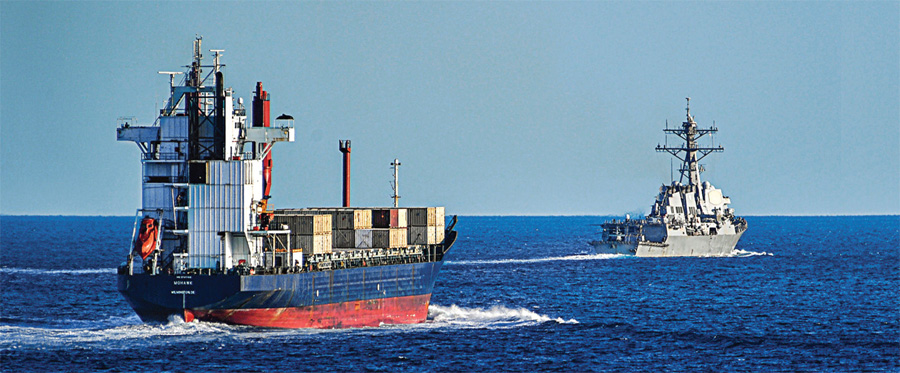
That is why the geography of geopolitics involves networks and territory, where geopolitics presents a combination of networks of economic relations and the political control of territory. The economic interests and other elements of global supply chains are forms of territorial geopolitics. That is why sea power is the essential component of force projection and control of overseas economic interests. i.e., Controlling networks of trade across oceans, and using that control to further interests onshore. Patterns of oceanic trade, and the military strength to secure and protect them, are a form of network geopolitics.
In this scope, remember the everlasting conflict between sea powers and continental powers. In order to control the Rimlands, Spykman said that it is essential for sea powers must maintain their control over the sea routes to secure their supply chains and to reach the continent’s shores, i.e. the Rimlands, to make them the basis for their advance towards the main lands, i.e the Heartland. This Network of activities are essential to maintain control of the main land resources.
That is why we must think of geopolitics as a process. Geopolitics is not static, and the geopolitical world is always changing. The back and forth of economic competition and military force leads to the expectation that the geopolitical world is ever changing. However, what is changing? Is it geography? Yes, but every simple change needs millions of years to occur, so what is rapidly changing?
2- Thucydides and the political structure reformation
The world’s political structure reformation is mainly a consequence of interests and alliances, which are the main causes of war. Thus, the political structure of the world is mainly a derivative of war consequences. This is what history tells us. Therefore, when we talk about geopolitics as a continuous process, this means that we need a continuous change, and when we say that this change is a derivative of war, this means that we always have war. However, why is there always war?
On this, Thucydides, a Greek historian who wrote the history of the Peloponnesian War between Sparta and Athens in the fifth century B.C. said that what made war inevitable was the growth of Athenian power and the fear such growth caused in Sparta. At that time, Sparta was the dominant ruling power, and Athens was a rising power that was trying to project its power and influence. This caused fear in Sparta since Athens was projecting its influence into Sparta’s region of effect. This caused war between the two cities. This logic makes it clear why there are tensions between the USA and Russia in the Caucasus region for example, explaining what happened in Georgia in 2008, when Russian forces invaded Georgia. The same happened in Ukraine starting in 2014. It is all about preserving national interests by confronting the western influence in these regions.
Let us look at China as another example. Going back to Thucydide’s view on war, China is a rising state, trying to build up its spheres of influence, regionally and internationally. This is paving the way towards what Graham Allison called in his book “Destined for War”, the Thucydides Trap, which is a deadly pattern of structural stress that results when a rising power challenges a ruling one, in a way that increases the tendency toward war. So again, thinking about the USA as a dominant ruling power, and China as a rising power, Allison wondered if the two states can escape Thucydide’s Trap, meaning if war was inevitable between the two countries, taking into consideration how Thucydides described the causes of war between Sparta and Athens.9

On the other hand, the USA is a dominant sea power, and China is a continental land power. However, why are the Chinese trying to build up their naval power and what are their main drivers to become a Sea power? Actually, the Chinese navy is the largest in the world, with respect to the ship count. Back to Spykman’s theory, the rimlands are the basis to control the main Lands, and China is one of the main rimlands to protect Eurasia, where China needs to protect its coastline and islands against the dominant sea powers, i.e., the USA, so having a superior Navy is essential for this. However, another main question arises here. Is it all about military might? Are military means the only means to achieve geopolitical goals? What about economy? Cyber? War of information? Can states lead through economic means? Can Mackinder’s heartland or Spykman’s rimlands be controlled primarily by economics?
This leads us to what we call the Gray Zone …. An area between peace and war. The grey-zone is the "competitive interactions among and within state and non-state actors that fall between the traditional war and peace duality."10 In this zone, economic coercion is a very important element, along with other elements such as cyber-attacks, sabotage, espionage, terrorism proxy wars, etc.
The Economic warfare is one dimension of the hybrid warfare alongside other dimensions of conventional and unconventional tools of warfare. When talking about conventional warfare, the military power will be its center of gravity; all other tools will be in support of the military, whereas in the hybrid warfare, the center of gravity focuses on the “broad spectrum of civil and military domains, all the tools will be in support of each other consecutively.”11
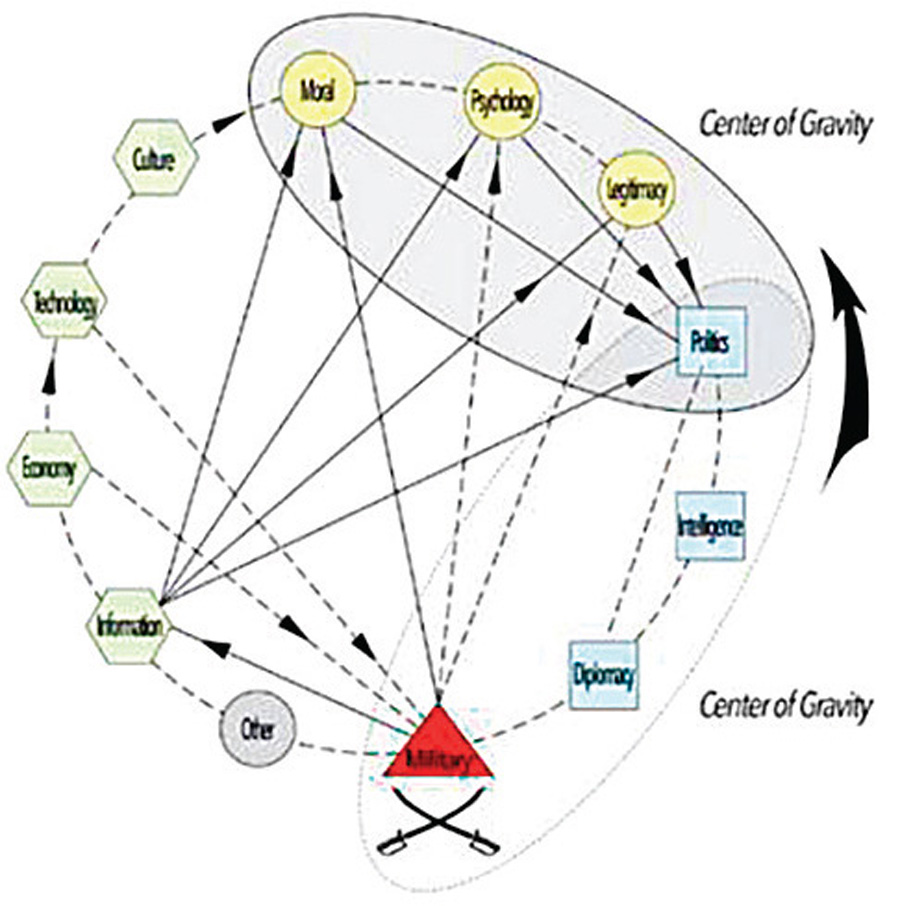
Hybrid warfare center of gravity12
This shows the importance of the economy as a dimension for projecting influence. About this, Samuel Huntington argued: “Economic activity … is, indeed, probably the most important source of power, and in a world in which military conflict between major states is unlikely, economic power will be increasingly important in determining the primacy of states.”13

3- Geo-economics and political economy
Geopolitics has a direct effect on the economy. The global economy can be affected by geopolitical events both directly and indirectly through financial, trade and commodity price channels. In terms of financial markets, this happens both through direct capital controls or financial sanctions, and indirectly through increased uncertainty and price surges. Obviously, this will cause what we call Geopolitical economic chaos, which is related to inflation, lower growth and significant welfare losses. Looking at the 1929 Great Depression14 as an example, seen as the major cause that set the international environment for the Second World War, which introduced two major economic systems that governed the global economy during the Cold War era, sparking new fundamental economic characteristics that dominated the international economy for about 40 years.
As such, it is important to be able to distinguish Political economy from Geo-economics. So what is Political economy? Political economy is the “study of how politics affects the economy and how the economy in turn shapes politics”.15 Examples of political economy systems are capitalism, socialism and communism. In capitalism, the economic system focuses on private ownership, free markets and profit motives, whereas in socialism; we have a mixed economy with public ownership, wealth equality and social welfare system. In communism, we see a classless society with central planning, collective ownership and common wealth. These descriptions of the types of political economy systems show how the state rules its economy and manages its economic policy concerning wealth distribution, ownership, industrial activities, and economic motives. This is different from what we call Geo-economics. On the other hand, there is a relation between geo-economics and the international political economy system, as geo-economics “can be understood as an extension of the sphere of geopolitics applied to international economic relations”.16
Primarily, geo-economics evolved as an idea in the wake of globalization. When the world’s economy became extremely interconnected, among other globalization features, the economy started to rise as a tool for foreign policy. It proved to be a very effective instrument to promote influence if used in a proper way. During the cold war era, military strength was the main tool that affected and controlled relations between the West and the East, where the international relations focused mainly on the concept of power for gaining influence. In post-Cold War era, following the collapse of the Soviet Union, the world entered what scholars call the globalization era. In this era, the USA projected its influence worldwide. In the absence of any opposite capable military power, the economy started to play an important role in promoting influence, where economically capable states tried to take a stand in this field, initiating international economic competition, where economic capabilities represent the main tool in preserving the national interests of each state.

4- The evolving concept of geo-economics
This signaled the beginnings of Geo-economics as an independent concept. This concept evolved through time. The use of the term Geo-economics stems back to the early 20th century, but only became popular in the 1990s. Initially, it referred to the economic value of geological resources, but reintroduced in the 1990s to be “the use of economic power for geopolitical influence”. Edward Luttwak was the first to coin this term in its new meaning. He described Geo-economics as the “admixture of the logic of conflict with the methods of commerce.17
Many other scholars used various definitions for the same term. For example, Leslie H. Gelb defined it as “the use of geopolitical or military power for economic ends”, 18 and Michael Mandelbaum saw it as the “entanglement of international economics, geopolitics, and strategy”. 19 Robert D. Blackwill and Jennifer M. Harris in their book “War by Other Means: GEO-ECONOMICS and Statecraft”, looked into geo-economics more deeply. They stressed that “today’s rising powers are increasingly drawn to economic instruments as their primary means of projecting influence and conducting geopolitical combat in the twenty-first century”. 20 Let us look into China as an example. How can we interpret its Belt and Road Initiative (BRI)? In short, this initiative uses China’s economic instruments to project Beijing’s influence, by building economic connections worldwide. Before China, the USA used an economic initiative directed towards Europe after the end of the Second World War called the Marshall Plan. This plan solidified the American influence in Western Europe to face the rising power of communism. Again, economy was its center of gravity and not the military might.
Looking at some basic drivers of globalization, we see that the increased economic interconnectivity is the leading phenomenon. The joint capital markets and the proliferation of free-trade agreements are the basis for such phenomenon. Organizations that regulate international trade such as the World Trade Organization (WTO)21 and the World Bank22 play an important role in this interconnectivity.23 Laying out united criteria for the global prosperity and successful economy made the world seem to be one huge firm of business. This led to a different understanding of how to evaluate the economy through the scope of international relations.
Hence, Geo-economics as an independent term took the lead in analyzing international relations and the foreign policies of different countries. It pursued to understand the interplay of economics and geopolitics, for example in trade, technology, finance, infrastructure, energy, and in access to critical raw materials. Research in geo-economics explores the impact of global economic fragmentation, and the future of economic statecraft tools.
Accordingly, Geo-economics includes the use of economic instruments as a means to achieve beneficial geopolitical ends. As such, beneficial geopolitical ends require a strong domestic economy over the long term, and this is a general requirement for any country’s power projection. Trade, sanctions, and resource control are some forms of the tools used to project power, making the economy a means. Therefore, the way to use economy as a means constitutes Geo-economics. With the shift to geo-economics, the focus has turned away from military ideas towards economic phenomena. The purpose of geo-economics is “to gain and maintain a national competitive advantage by economic means”.24 Military Warfare, in the same sense is no more than the ultimate means of achieving that same goal, but upon choosing armed war, it is better to be certain that this kind of war will primarily lead to a better economic situation,25 else, it will definitely be a wrong option, unless it was not a war of choice.
Robert D. Blackwill and Jennifer M. Harris put a comprehensive definition for Geo-economics that covers a full scope of the idea from where this term was born. They saw Geo-economics as “the use of economic instruments to promote and defend national interests and to produce beneficial geopolitical results; and the effects of the other nations’ economic actions on a country’s geopolitical goals”.26 In this definition, the concept of “National Interests” conclude the whole figure.
As Sun Tzu said, the supreme art of war is to subdue the enemy without fighting. Looking into Blackwill and Harris’s definition for geo-economics, and putting it in the frame of Sun Tzu’s quote, we conclude that Geo-economics is used to subdue the enemy without fighting, and making the enemy do what we need without going to military war, hence, defending our nation’s interests and achieving our geopolitical gains by using economic tools. Furthermore, securing the state’s national interests is the backbone of any strategy drafted to achieve the National Ends, which are usually in terms of geopolitics by geo-economic and non-geo-economic goals.

5- Geopolitics and geo-economics
Resulting from all what has been mentioned before, geo-economics is defined as the use of economic means by international actors to structurally influence world power distribution, and to achieve geopolitical goals. This results in a specific relation between geopolitics and geo-economy. Geopolitics and geo-economics are two separate concepts but tied to each other. While geopolitics refers to the study of geographical factors’ impact on political decisions and the relationships between countries, geo-economics focuses on employing economic tools to promote and defend national interests and produce efficient geopolitical results.
The distinction between the two approaches is not always clear, since in reality they often overlap. For example, geopolitical factors such as territorial conflicts or military alliances can affect trade policy and investment decisions, and geo-economic factors such as trade agreements or economic sanctions can influence the geopolitical dynamics between countries. By combining geopolitical and geo-economic factors in strategic planning, we can navigate the challenges and opportunities presented by the changing power balance between the major economic powers, the emergence of trade routes and new markets and the ongoing conflicts that shape the global trade and investment rules.
In addition, shaping the global trade for instance must be in favor of the state. This shaping acts as a tool for power projection, but within the turbulent, uncertain and complex environment, this might have some risks, mostly because the increasing interdependence of national economies through globalization creates varying degrees of dependency and vulnerability.27 National economies will become more dependent on each other, where this will create gaps that will affect the nation’s sovereignty.
Moreover, the national economies’ dependency is measured in relation to economic power and geopolitics within many dimensions. A nation’s economic performance is one dimension; International economic policy is another, all combined with the economic instruments applied in pursuit of geopolitical and economic ends. Nevertheless, the search for geopolitical and economic ends can sometimes be “unclear”, where “States can and often design GEO-ECONOMIC policies that simultaneously advance multiple interests—geopolitical, economic, and otherwise.”28 Moreover, the geopolitical and economic ends might coincide together in such a way that it is very difficult to split them from each other, but at the very end, they both must serve as a tool to preserve the national interests, defining what states refer to, in the political environment, as the national security.
Economic power and geo-economic instruments support a country’s national security by contributing to a strong economy, enabling effective international economic policy, and applying economic statecraft to the accomplishment of geopolitical goals. However, how to accomplish these goals?
Mainly, statecraft refers to the means by which governments pursue foreign policy, and can be categorized into four primary instruments: diplomacy (negotiations and deals), information (words and propaganda), military force (weapons and violence), and economics (goods and money).29 These means constitutes the instruments of National power, referred to as the DIME. In addition, these instruments may include finance, intelligence and legal/Law enforcement (DIMEFIL), and even security (DIMEFIL-S).
Moreover, the instruments of power of a country are usually the tools used to implement the national foreign policy objectives. Economics is one important tool, and its applications vary from trade agreements, international economic organizations (WTO, NAFTA30, GATT31), categorized as soft economic power tools, to the use of economic sanctions against a state opponent as a hard economic tool, and all that is included between the two. However, even the soft economic power includes some hard power acts. The economic agreements between uneven countries will not necessarily be fair for all, especially when poor countries are seeking economic help. Again, the World Trade Organization, for instance, contain within its framework many unfair obligations when it comes to poor countries contributions.
On the other hand, the hard economic power can include some soft power engines, when sanctions, for example, are set against a ruling group only, and this is used as propaganda against the ruling regime, in countrie’s where the government is unresponsive to its citizenry.
Again, the interplay between economic hard and soft power instruments is clear. For example, if there are no trade relations between two countries, how can one of them sanction the other? This can be done through a third party. In this sense, a conflict between two countries may negatively affect a third one, and produce mutual risks to its economy. Look at the USA sanctioning Cuba because of its trade with Venezuela, or China because of its trade with Iran, and so on. There is no state on the globe totally isolated in economic terms. Even North Korea, known for isolating itself from other nations, established trade relations with China, and recently with Russia. So economic interdependency is necessary in today’s economic structure, even if it varies between countries, as being very or partially dependent on other economies. This leads us to explore economy as a tool for foreign policy.
Geo-economics enables some states to use new foreign policy tools. Geo-economic tools may be available to some countries but not to other countries.32 This shows how economy can be a tool of distinction between states. Geo-economics can change the international system, since employing geo-economic tools can change the nature of the markets worldwide. Geo-economically minded deals could change how entire markets operate, especially in strategically important sectors.33 Geopolitically motivated deals can become important factors in a given state’s foreign policy calculus. A state’s strategic investments in other countries are informative in this case. These investments will enforce certain policies on the state.34

6- Geo-strategy in the equation
The hierarchical formulation of geopolitics, geo-economics and geo-strategy suggests a deep and strong relation that joins the three concepts together. To achieve the geopolitical goals, the need to consider all instruments available to make strategies tangible is crucial.
As mentioned, geopolitics and geo-economics are related. In addition, the geopolitical goals in general are of two types, some are geo-economics-based and the others are not. These goals are achieved through strategic planning. This planning is usually organized in accordance with the state’s national interests and by implementing the state’s Grand Strategy. The use of the state’s instruments of national power to allocate resources (the Means), to the objectives (the Ends), is affected by the Geographical factors that influence the political actions.35 We refer to this planning as Geo-strategy.
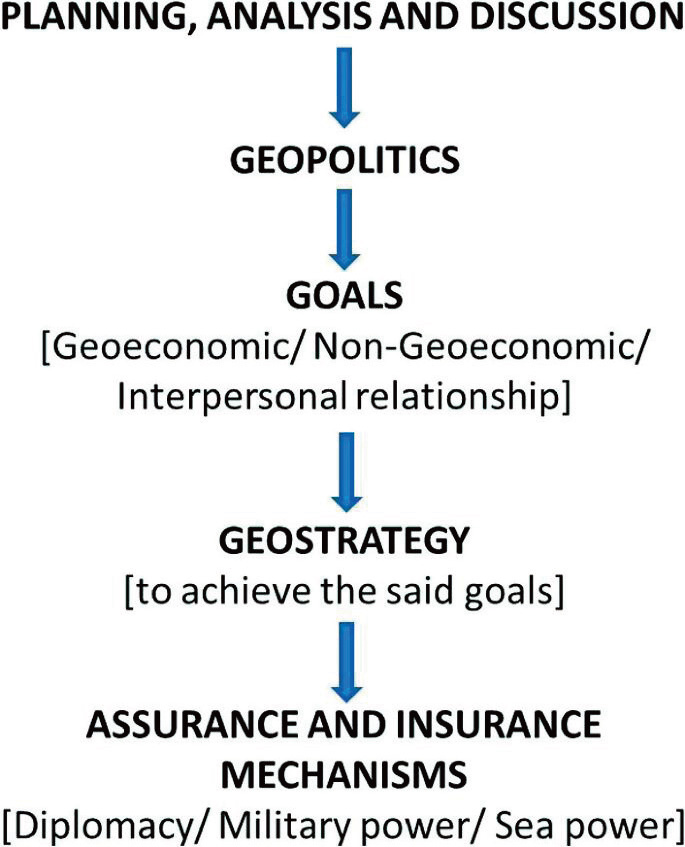
Hierarchical formulation of geopolitics, geo-economics and geo-strategy36
Geostrategic thought is rooted in the intersection of geography and strategy, and Geostrategic studies have profoundly influenced the formulation of states' internal and external policies.37 Geo-strategy is relevant principally to the environment in which it evolved, which include the strength of the country's resources, the scope of the country's goals, the political geography of the time-period, and the technological factors that affect military, political, economic, and cultural engagement. Geo-strategy can function prescriptively, advocating foreign policy based on geographic and historical factors, analytically, describing how foreign policy is shaped by geography and history, or predictively, projecting a country's future foreign policy decisions and outcomes.38
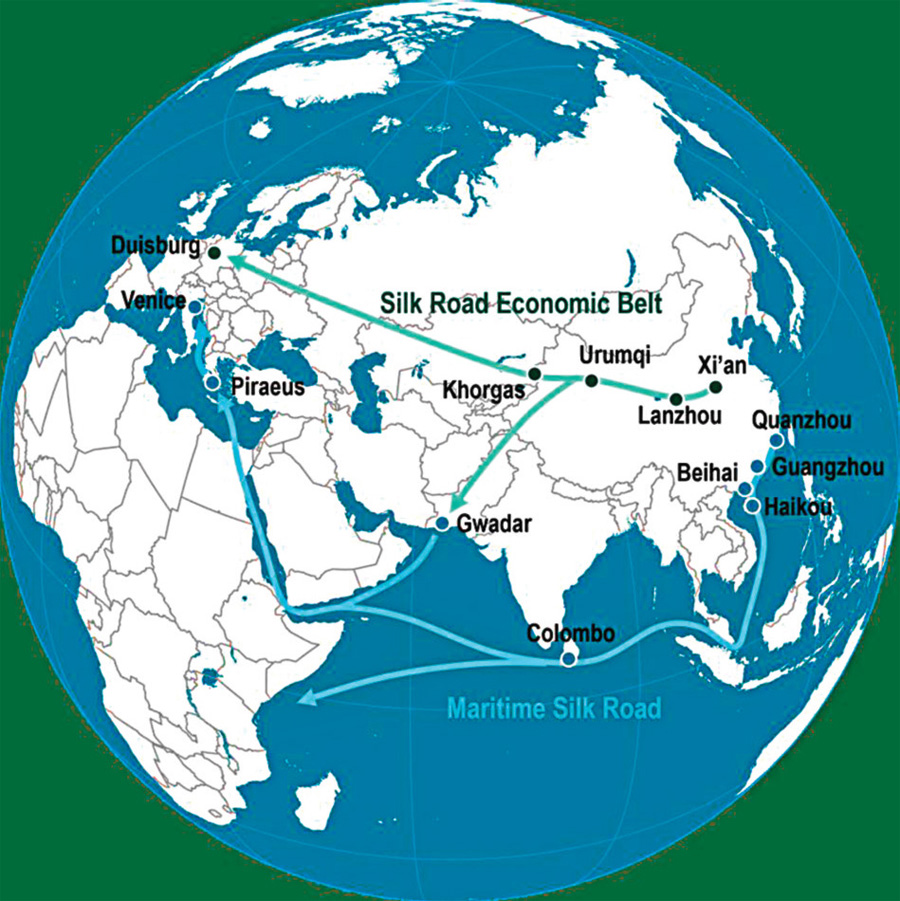
The Belt and Road Initiative39
As such, the interplay between Geo-economy and Geo-strategy is factual. The economic means of power can be a major tool to achieve strategic objectives. Examples of this are the Marshall plan and the BRI. Both used the power of the economy to achieve political strategic objectives. The first helped the USA to counter the communist propaganda stopping its expansion towards the western countries, thus promoting the American influence and expanding the US ideals through the western sphere of the continent. On the other hand, the BRI, by using Chinese economic power aimed to promote the Chinese influence in the countries included in its structure.
Conversely, any Grand Strategy can augment economic power. The other instruments of National power can help the economy flourish. A good example may be the annexation of the Crimean Peninsula by Russia in 2014. This annexation marked the beginning of breaking point moments in contemporary geopolitical discussions. The geopolitical significance of Crimea is indisputable. A region with oil and gas reserves would help the Russian economy. Former Russian Minister of Natural Resources and Ecology, Sergei Donskoi, announced that Crimean territory has 44 hydrocarbon fields, 7 gas condensate reservoirs, and 10 oil and 27 gas fields.40
On the other side, the Crimean Peninsula is in a geopolitically significant position within the Black Sea that allows Russia to maintain a strong naval presence in the Black and Mediterranean Seas. Such an act allowed Russia to take control over Sevastopol harbor, allowing its Navy to guard and control the trade routes in the Black Sea, even in wintertime, when all other Russian harbors are out of service because of the severe freezing weather, and at the same time, allowing Russian exports and imports through this harbor also.
Another example would be the Iraqi invasion of Kuwait in 1991. In addition to other political aims that triggered this invasion, Kuwait’s oil overproduction negatively affected oil prices, causing severe losses in the Iraqi oil revenues, while Iraq was trying to build up its economy after its war with Iran. This invasion helped Iraq control all the Kuwaiti oil, and easing pressure on its economy.41 Although this did not last for a long time due to the international intervention to liberate Kuwait, but the Iraqi strategy then was aiming to augment Baghdad’s economy.
Therefore, considering the triangle formed by Geopolitics, Geo-strategy and Geo-economics, the links between the three concepts are strong. Looking at Geopolitics as a factor for power distribution depending on the geographic factors implications, this is highly linked with Geo-strategy in formulating and planning grand strategies and military operations for territorial control, where the use of economic means is essential for this aim, i.e. using Geo-economics to help achieve this goal. Vice versa, the use of economic means to structurally influence the world power distribution, i.e. Geo-economics, is highly associated with the geographic factors impacting this distribution, in the scope of international relations, resources and markets, involves the formulation of grand strategies that fulfill these goals, mainly using hard power in securing them.
Conclusion
Any attempts to understand the evolution of the global order would be useless without acknowledging the impact of economic, financial, and technological shifts. Diplomatic and military power derive from economic strength. Secretary of State, Hillary Clinton, stressed the importance of the economy in identifying this relation. She elaborated that the first is “how we harness the forces and use the tools of global economics to strengthen our diplomacy and presence abroad”—applying economic means to achieve geopolitical ends, and the second part is how “to transform the geopolitical ends into means to help accomplish the ends of domestic economic prosperity”.42
Therefore, Geo-economics in this perspective owes its modern resurgence primarily to three factors. The first is that today’s rising powers are increasingly drawn to economic instruments as their primary means of projecting influence and conducting geopolitical combat in the twenty-first century. The second factor is that those states most prone to economic displays of power today have vastly more resources at their direct disposal. For example, governments, not private shareholders, now own the world’s 13 largest oil and gas firms and 75 percent of the world’s energy reserves. This shows the emergence of a new generation of state capitalists. The third factor is related to changes to global markets themselves. Today’s markets—deeper, faster, more leveraged, and more integrated than ever before—exert more influence over a nation’s foreign policy choices and outcomes.43
Blackwill and Harris count seven tools suitable for geopolitical application, trade policy, investment policy, economic and financial sanctions, financial and monetary policy, aid, cyber, and energy and commodities.44 These policies describe the economic statecraft in any country, and how this country uses the various economic tools, such as lending, foreign assistance, sanctions, and trade agreements—to advance its foreign policy priorities. Why, for example, China lend other nations billions of dollars each year through its Belt and Road Initiative?
In the scope of international relations, Geo-economics constitutes many characteristics. It links economy and national security. In principle, the WTO agreement provides for the possibility for its members to use national security as grounds for restrictive trade measures. In addition, it allows the use of infrastructure as a projection of national power. In a geo-economic world, great powers may increasingly seek to shield off their strategic and economic interests and aim at establishing asymmetrical relationships with others. They may try to master connections by developing their own infrastructure networks.
Moreover, it illustrates the use of financial policy for geo-political purposes, where financial networks are tools of geo-economics. Furthermore, it enables the use of economic sanctions to achieve political goals, where such sanctions are the classic tools of geo-economics. Upon applying sanctions over time, they can not only re-direct trade flows, but also affect the technological development of a country, weaken the population, lead to possible uprisings or even regime change. The extent to which sanctions also hurt the domestic economy of a sanctioning state depends on market size and trade flows.
Why is that possible? Again, because of the web connecting security, politics, economy, resources and geography together worldwide. This connectivity paves the way for the application of the Geo-economic approach in the international relations system.
Overall, the state’s interests rule its interactions with other states, in correlation with its final geopolitical ends. Mainly, States maintain their interests that are the forces generating international conflicts and originating tensions. Hence, Geo-economics plays a crucial role in promoting and defending these interests in a geopolitical environment.
References
1.“Getting to Know the World Bank”, The World Bank Group, https://www.worldbank.org/en/news/feature/2012/07/26/getting_to_know_theworldbank
2.“Political Economy. Understanding how societies work”, https://www.gov.harvard.edu/ undergraduate/programs-of-study/political-economy/
3.“The Belt and Road Initiative (BRI)”, Port Economics, Management and Policy, https://porteconomicsmanagement.org/pemp/contents/part2/port-hinterlands-regionalization/belt-and-road-initiative-bri/
4.“The WTO”, https://www.wto.org/english/thewto_e/thewto_e.htm
5.Aaron Miller, “The Link Between Geography and U.S. Foreign Policy Has Grown More Complex”, Carnegie endowment, April 2023, https://carnegieendowment.org/posts/ 2023/04/the-link-between-geography-and-us-foreign-policy-has-grown-more-complex?lang=en
6.Ana Bojinovic. (2005). Geographical Proximity and Historical Experience as a Basis for Active Foreign Policy Strategy of Small European States – the Case of Austria and Slovenia regarding the Western Balkans. Politics in Central Europe, 1(1), 8-29. https://nbn-resolving.org/urn:nbn:de:0168-ssoar-61231
7.Benn Steil and Robert E. Litan, Financial Statecraft: The Role of Financial Markets in American Foreign Policy (New Haven, CT: Yale University Press, 2006).
8.Bruna Jaeger and Pedro Brites, “Geoeconomics in the light of International Political Economy: a theoretical discussion”, Brazilian Journal of Political Economy, vol. 40, nº 1, January-March/2020.
9.Daniel Chardell, “THE ORIGINS OF THE IRAQI INVASION OF KUWAIT RECONSIDERED”, Texas National Security Review: Vol. 6, Issue 3, Summer 2023, pp. 52-78.
10.Edward N. Luttwark, “From Geopolitics to Geo-Economics: Logic of Conflict, Grammar of Commerce,” The National Interest, no. 20 (Summer 1990).
11.Harfold Mackinder, “The Geographical pivot of history”, The Geographical Journal, Vol. xxiii, no. 4, 421-437, p 435, https://www.jstor.org/stable/1775498
12.Harfold Mackinder, Democratic Ideals and Reality, (Washington DC: National Defense University press, 1942).
13.Hillary Clinton, “Sidebar on Economic Statecraft,” U.S. Department of State (website), 15 November 2011, accessed 9 November 2017, https://www.state.gov/s/d/rm/ rls/perfrpt/2011/html/178731.htm
14.Igor Kovac, Definitions of Geopolitics, Oxford Research Encyclopedia, https://oxfordre.com/internationalstudies/display/10.1093/acrefore/9780190846626.001.0001/acrefore-9780190846626-e-823?d=%2F10.1093%2Facrefore%2F9780 190846626.001.0001%2Facrefore-9780190846626-e-823&p=emailAY3V8cMHbytFk
15.Javad Keypour and Ivar Hendla, “The Annexation of Crimea: A Realist Look from the Energy Resources Perspective”, Baltic Journal of European Studies, Tallinn University of Technology (ISSN 2228-0588), Vol. 9, No. 3 (28).
16.Jean Gottman, "The Background of Geopolitics," Military Affairs, 6 (Winter 1942).
17.Johann Schmid, “The archetype of hybrid warfare”, Hybrid CoE, 27 October 2020, https://www.hybridcoe.fi/news/the-archetype-of-hybrid-warfare/
18.Joseph S. Nye Jr., The Future of Power (New York: Public Affairs, 2011).
19. Klaus Søilen, Geoeconomics, bookboon.com, https://frokenbors.se/wpcontent/ uploads/2016/01/geoeconomics.pdf
20.Leslie H. Gelb, “GDP Now Matters More than Force,” Foreign Affairs, November/December 2010.
21.Michael Mandelbaum, The Road to Global Prosperity (New York: Simon and Schuster, 2014).
22.Nicholas J. Spykman, The Geography of Peace (New York: Harcourt & Brace, 1944).
23.Nitin Agarwala & Rana Divyank Chaudhary, “China’s Geopolitical, Geoeconomic and Geostrategic Gameplay in the Indian Ocean Region”, in Rebalancing Asia, Edited by Jaiswal, and Bhatt, Springer, Singapore. https://doi.org/10.1007/978-981-16-3757-5_3
24. Philip Kapusla, The Gray Zone, Special Warfare, October-December 2015, https://www.soc.mil/SWCS/SWmag/archive/SW2804/GrayZone.pdf
25.Robert D. Blackwill and Jennifer M. Harris, War by Other Means: GEO-ECONOMICS and Statecraft (Cambridge, MA: The Belknap Press of Harvard University Press, 2016).
26.Rohullah Muradi, “Investigation of Geographical Factors of National Power”, Journal for Research in Applied Sciences and Biotechnology, Vol. 3 Issue 1, February 2024, pp. 44-49.
27.Samuel Huntington, “Why International Primacy Matters,” International Security 17, no. 4 (Spring 1993).
28.Sofiane BELMADI, INTRODUCTION TO GEOSTRATEGIC AND GEOPOLITICAL STUDIESFOUNDATIONS AND CONCEPTS (Ali Lounici University - Blida 2: Algeria Shield for Comprehensive Security and Strategic Studies Laboratory, 2025).
29.Thomas L. Friedman, The Lexus and the Olive Tree: Understanding Globalization (New York: Anchor Books, 2000).
30.Thucydides- The Peloponnesian War, Translated by Martin Hammond (New York, Oxford University Press, 2009).
31.Will Kenton, “What Was the North American Free Trade Agreement (NAFTA)?”, Investopedia, 26 June, 2024, https://www.investopedia.com/terms/n/nafta.asp
32.Zakaria Imessaoudene, “The Rise of Geoeconomics”, Geneva Graduate Institute, https://globalchallenges.ch/issue/12/the-rise-of-geoeconomics/
1. Zakaria Imessaoudene, “The Rise of Geoeconomics”, Geneva Graduate Institute,https://globalchallenges.ch/issue/12/the-rise-of-geoeconomics/
2. Igor Kovac, Definitions of Geopolitics, Oxford Research Encyclopedia, https://oxfordre.com/internationalstudies/display/ 10.1093/acrefore/9780190846626.001.0001/acrefore-9780190846626-e-823?d=%2F10.1093%2Facrefore% 2F9780190846626.001.0001%2Facrefore-9780190846626-e-823&p=emailAY3V8cMHbytFk
3. Jean Gottman, "The Background of Geopolitics," Military Affairs, 6 (Winter 1942), 197.
4. Mackinder's Heartland Theory focuses on the control of the interior of Eurasia, specifically the region surrounding the heart of the continent, as the key to global power. Spykman's Rimland Theory, on the other hand, focuses on the coastal regions, or rimlands, surrounding Eurasia, as the key to controlling the world.
5. Aaron Miller, “The Link Between Geography and U.S. Foreign Policy Has Grown More Complex”, Carnegie endowment, April 2023, https://carnegieendowment.org/posts/2023/04/the-link-between-geography-and-us-foreign-policy-has-grown-more-complex?lang=en
6. Harfold Mackinder, “The Geographical pivot of history”, The Geographical Journal, Vol. xxiii, no. 4, 421-437, p 435, https://www.jstor.org/stable/1775498.
7. Harfold Mackinder, Democratic Ideals and Reality, (Washington DC: National Defense University press, 1942), p 106.
8. Nicholas J. Spykman, The Geography of Peace (New York: Harcourt & Brace, 1944), p. 43.
9. Thucydides wrote about the Peloponnesian War between Athens and Sparta: "In my view the real reason, true but unacknowledged, which forced the war, was the growth of Athenian power and Spartan fear of it." See: Thucydides- The Peloponnesian War, Translated by Martin Hammond (New York, Oxford University Press, 2009), 13.
10. Philip Kapusla, The Gray Zone, Special Warfare, October-December 2015, p 20, https://www.soc.mil/SWCS/SWmag/ archive/SW2804/GrayZone.pdf
11. Johann Schmid, “The archetype of hybrid warfare”, Hybrid CoE, 27 October 2020, https://www.hybridcoe.fi/news/the-archetype-of-hybrid-warfare/
12. Ibid.
13. Samuel Huntington, “Why International Primacy Matters,” International Security 17, no. 4 (Spring 1993): 72.
14. Worldwide economic downturn that began in 1929 and lasted until about 1939. It was the longest and most severe depression ever experienced by the industrialized Western world, sparking fundamental changes in economic institutions, macroeconomic policy, and economic theory, see Britannica, https://www.britannica.com/event/Great-Depression
15. “Political Economy. Understanding how societies work”, https://www.gov.harvard.edu/undergraduate/programs-of-study/political-economy/
16. Bruna Jaeger and Pedro Brites, “Geoeconomics in the light of International Political Economy: a theoretical discussion”, Brazilian Journal of Political Economy, vol. 40, nº 1, January-March/2020, p23.
17. Edward N. Luttwark, “From Geopolitics to Geo-Economics: Logic of Conflict, Grammar of Commerce,” The National Interest, no. 20 (Summer 1990): 19.
18. Leslie H. Gelb, “GDP Now Matters More than Force,” Foreign Affairs, November/December 2010, 35
19. Michael Mandelbaum, The Road to Global Prosperity (New York: Simon and Schuster, 2014), xvi– xvii.
20. Robert D. Blackwill and Jennifer M. Harris, War by Other Means: GEO-ECONOMICS and Statecraft (Cambridge, MA: The Belknap Press of Harvard University Press, 2016), 33–34.
21. The World Trade Organization (WTO) is the only global international organization dealing with the rules of trade between nations. At its heart are the WTO agreements, negotiated and signed by the bulk of the world’s trading nations and ratified in their parliaments. The goal is to ensure that trade flows as smoothly, predictably and freely as possible. See “The WTO”, https://www.wto.org/english/thewto_e/thewto_e.htm
22. The World Bank is an international development organization. Its role is to reduce poverty by lending money to the governments of its poorer members to improve their economies and to improve the standard of living of their people. See “Getting to Know the World Bank”, The World Bank Group, https://www.worldbank.org/en/news/feature/ 2012/07/26/getting_to_know_theworldbank
23 Thomas L. Friedman, The Lexus and the Olive Tree: Understanding Globalization (New York: Anchor Books, 2000), p 12.
24. Klaus Søilen, Geoeconomics, bookboon.com, p 22, https://frokenbors.se/wpcontent/uploads/2016/01/geoeconomics.pdf
25. Ibid.
26. Blackwill and Harris, Op.cit. p 20.
27. Joseph S. Nye Jr., The Future of Power (New York: Public Affairs, 2011), p 5.
28. Blackwill and Harris, Op.cit, pp. 27-31.
29. Benn Steil and Robert E. Litan, Financial Statecraft: The Role of Financial Markets in American Foreign Policy (New Haven, CT: Yale University Press, 2006), 1.
30. North American free trade agreement was implemented to promote trade between the U.S., Canada, and Mexico. The agreement, which eliminated most tariffs on trade between the three countries, went into effect on Jan. 1, 1994. See Will Kenton, “What Was the North American Free Trade Agreement (NAFTA)?”, Investopedia, 26 June, 2024, https://www.investopedia.com/terms/n/nafta.asp
31. General Agreement on Tariffs and Trade, signed in 1947 by 23 countries, is a treaty minimizing barriers to international trade by eliminating or reducing quotas, tariffs, and subsidies. It was intended to boost economic recovery after World War II. See Christina Majaski, “What Is the General Agreement on Tariffs and Trade (GATT)?”, Investopedia, 28 June, 2024, https://www.investopedia.com/terms/g/gatt.asp
32 Blackwill and Jennifer M. Harris, Op.cit, pp.40-43
33 Ibid.
34 Ibid, 45.
35. Rohullah Muradi, “Investigation of Geographical Factors of National Power”, Journal for Research in Applied Sciences and Biotechnology, Vol. 3 Issue 1, February 2024, p 45-46.
36. Nitin Agarwala & Rana Divyank Chaudhary, “China’s Geopolitical, Geoeconomic and Geostrategic Gameplay in the Indian Ocean Region”, in Rebalancing Asia, Edited by Jaiswal, and Bhatt, Springer, Singapore. https://doi.org/10.1007/978-981-16-3757-5_3
37. Sofiane BELMADI, INTRODUCTION TO GEOSTRATEGIC AND GEOPOLITICAL STUDIESFOUNDATIONS AND CONCEPTS (Ali Lounici University - Blida 2: Algeria Shield for Comprehensive Security and Strategic Studies Laboratory, 2025), 1.
38. Ana Bojinovic. (2005). Geographical Proximity and Historical Experience as a Basis for Active Foreign Policy Strategy of Small European States – the Case of Austria and Slovenia regarding the Western Balkans. Politics in Central Europe, 1(1), 8-29. https://nbn-resolving.org/urn:nbn:de:0168-ssoar-61231
39. “The Belt and Road Initiative (BRI)”, Port Economics, Management and Policy, https://porteconomicsmanagement.org/pemp/ contents/part2/port-hinterlands-regionalization/belt-and-road-initiative-bri/
40. Javad Keypour and Ivar Hendla, “The Annexation of Crimea: A Realist Look from the Energy Resources Perspective”, Baltic Journal of European Studies, Tallinn University of Technology (ISSN 2228-0588), Vol. 9, No. 3 (28), p155.
41. Daniel Chardell, “THE ORIGINS OF THE IRAQI INVASION OF KUWAIT RECONSIDERED”, Texas National Security Review: Vol. 6, Issue 3, Summer 2023, p 54.
42. Hillary Clinton, “Sidebar on Economic Statecraft,” U.S. Department of State (website), 15 November 2011, accessed 9 November 2017, https://www.state.gov/s/d/rm/rls/perfrpt/2011/html/178731.htm
43. Blackwill and Jennifer M. Harris, Op.cit, pp.36-37
44. Ibid, 49
الجيو- اقتصاد... تحويل الاقتصاد إلى سلاح
العميد الركن ريمون فرحات
شهدت نهاية الحرب الباردة نقطة تحول جوهرية في نمط إدارة السياسة الدولية؛ حيث تراجعت الجغرافيا السياسية التقليدية (Geopolitics) القائمة على الصدام العسكري المباشر لحساب الجيو-اقتصاد (Geo-economics) كآلية محورية لتوجيه السياسات الخارجية وتأمين المصالح القومية. وفي ظل نظام عالمي شديد التعقيد والتغير، تلاشت الحروب العسكرية التقليدية بين القوى الكبرى لتفسح المجال أمام صراعات وتنافسات تحتكم إلى أدوات النفوذ المالي والتجاري لإعادة توزيع القوة عالميًا.
يُعرَّف الجيو-اقتصاد بأنه استخدام الفاعلين الدوليين للوسائل الاقتصادية بهدف التأثير الهيكلي على توزيع القوى العالمي وتحقيق الغايات الجيوسياسية. ورغم التمايز المفاهيمي بين الجيو-سياسة التي تدرس أثر الجغرافيا على القرار السياسي، والجيو-اقتصاد الذي يركز على توظيف المال والتجارة لحماية الأمن القومي، إلا أنهما يمثلان وجهين لعملة واحدة في استراتيجيات الدول.
يتجلى هذا الترابط عمليًا في التأثير المتبادل، حيث تحدد التحالفات العسكرية والصراعات الإقليمية (أبعاد جيو-سياسية) توجهات التجارة والاستثمار، وبالمقابل، تعيد العقوبات والاتفاقيات التجارية (أبعاد جيو-اقتصادية) تشكيل الديناميكيات السياسية بين الدول. هذا التلازم يدفع الدول المعاصرة لدمج البُعدين في تخطيطها الاستراتيجي لاستشراف موازين القوى وإدارة طرق التجارة الناشئة.
وتظهر القوة الاقتصادية كأداة لا غنى عنها لتحقيق الأهداف الجيو-استراتيجية العليا، وتُقدم الذاكرة السياسية المعاصرة نمطين بارزين لهذا التوظيف:
خطة مارشال الأميركية: التي استخدمت الدعم المالي لإعادة إعمار أوروبا الغربية كحائط صدّ ضد التمدّد الشيوعي.
مبادرة الحزام والطريق (BRI): التي توظف من خلالها الصين قدراتها الإنتاجية والتمويلية لربط واحتواء الدول المشاركة في فلك نفوذها.
وعلى الجانب الآخر، يمكن للاستراتيجيات الكبرى (بما فيها الأدوات العسكرية) أن تعمل في خدمة الاقتصاد. ويُعد ضم روسيا لشبه جزيرة القرم العام 2014 نموذجًا مثاليًا؛ إذ حقق لروسيا مكاسب اقتصادية هائلة بالسيطرة على عشرات حقول النفط والغاز، إلى جانب مكاسب جيو-استراتيجية تجارية تمثّلت في التحكم بـ ميناء سيفاستوبول الحيوي في البحر الأسود، مما أمّن خطوط التجارة والصادرات الروسية حتى في فترات الشتاء القارس.
إن فهم تطور النظام الدولي الراهن يرتكز على حقيقة أن القوة الدبلوماسية والعسكرية تنبع أساسًا من المتانة الاقتصادية. وتتضح هذه العلاقة الجدلية في قدرة الدول على «تسخير الاقتصاد لخدمة النفوذ الخارجي»، وفي الوقت ذاته «تحويل المكاسب السياسية الخارجية إلى ازدهار اقتصادي داخلي».
